Eat, Pray, Love: The Real Places in Italy That Inspired the Film
Content index
From Rome to Naples, through Tuscany and Venice: a guide for those who want to live it, not just watch it.
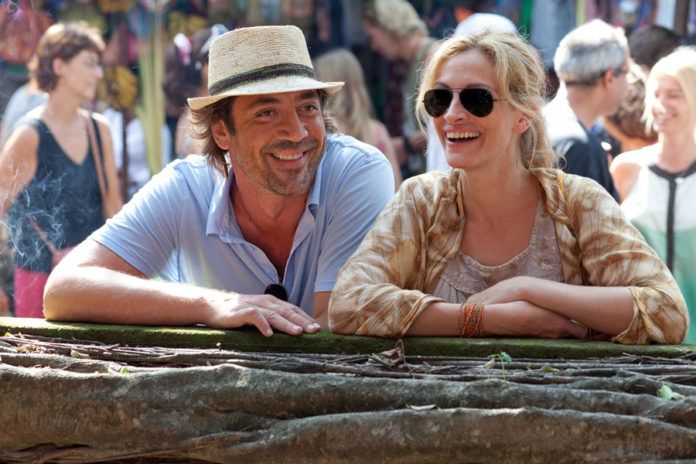
Eat, Pray, Love is not just a film. It is one of the works responsible for bringing generations of travelers to Italy with a specific list of places, dishes, and moments that had to be experienced. Elizabeth Gilbert’s memoir, adapted for cinema in 2010 with Julia Roberts in the leading role, turned Rome, Naples, and Tuscany into pilgrimage destinations for those seeking pleasure, presence, and reinvention.
This guide explores the real places that appear in the book and in the film, with what is worth doing in each one, what to eat, and what not to miss.
Editorial note: The film was shot partly in real locations in Italy and partly in studio. The recommendations below refer to the real places that inspired the book and to confirmed filming locations.
◆ Lazio · Capital
Rome: The “Eat” Part
Rome is where everything begins. Gilbert arrives in the Italian capital with one single goal: to learn how to receive pleasure without guilt. The city, with its gastronomic tradition, its markets, and its routine of moving from bar to bar, works as the ideal teacher for someone who needs to relearn how to enjoy the present.
The Film’s Locations in Rome
Click a marker for details · Map via CartoDBPiazza Navona
What it is
One of Rome’s most beautiful Baroque squares, built over the ancient Stadium of Domitian. It is dominated by Bernini’s Fontana dei Quattro Fiumi (1651), one of the city’s most important works of public art. In the film, it appears as the backdrop for Liz’s walks and moments of contemplation.
What to do
Sit at one of the square’s cafés at sunset, when the light changes and the movement begins to gain rhythm. Watch the street artists, the musicians, and the Roman families passing by. It is one of the squares where Roman life displays itself without ceremony.
Practical tip: Avoid the restaurants on the square itself, which are aimed at tourists and have inflated prices. Eat well two blocks away.
Campo de’ Fiori
What it is
An open-air market that operates every morning (except Sunday) in Rome’s historic center, just a few minutes from Piazza Navona. It is one of the city’s oldest markets, with stalls selling fruit, vegetables, flowers, cheeses, spices, and bread.
Why go
This is where Gilbert learns to shop with intention, to look at ingredients as a starting point for pleasure, not merely as a necessity. Arriving early (before 10 a.m.) guarantees the best products and fewer crowds.
What to buy
Marinated olives, fresh pecorino cheese, pane di Casa, and Pachino tomatoes if they are in season. The quality of the products is real and the prices are reasonable for the city center.
Gelateria del Teatro
What it is
One of Rome’s most respected artisanal gelaterias, located near the Pantheon, on Via dei Coronari. It works with seasonal flavors and unusual combinations: basil with Sicilian lemon, fig with ricotta, lavender with honey.
Why it matters
In the book, gelato appears as a symbol of permission, of eating purely for pleasure without justification. Gilbert describes a scene in which she eats two gelatos in a row and decides that this is perfectly fine. For those who have read the book, stopping at this gelateria is a moment of complicity with that memory.
Address: Via dei Coronari 65, Rome. Open daily. Arrive hungry.
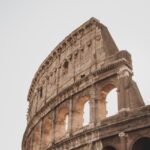
The Colosseum and the Roman Forum
What they are
The Flavian Amphitheatre, known as the Colosseum, was inaugurated in 80 AD and could hold up to 80,000 spectators. Together with the Roman Forum and the Palatine Hill, it forms the largest open-air archaeological complex in Europe.
Context in the film
Rome is not only gastronomic pleasure in Eat, Pray, Love. It is also an encounter with a history that is larger than any personal problem. Visiting the Colosseum helps recalibrate perspective, which is, at its core, one of the central themes of the book.
How to visit well
Book online in advance, especially between May and September. The Colosseum + Forum + Palatine combo is included in a single ticket. Prefer the first hours of the morning or the end of the day to avoid peak heat and visitor crowds.
◆ Campania · Southern Italy
Naples: Where Pizza Is a Philosophical Matter
Gilbert goes to Naples specifically to eat the best pizza in the world. This choice is not random: Naples is the place where pizza was invented, where tradition is taken with almost religious seriousness, and where eating well costs very little.
The city appears in the book and in the film as chaotic, noisy, unpredictable, and absolutely real. It is not postcard Italy. It is a city that makes no concessions to tourism, and that is exactly why it is so worthwhile.
The Film’s Locations in Naples
Click a marker for details · Map via CartoDBAntica Pizzeria da Michele
What it is
Founded in 1870 on Via Cesare Sersale, in Naples’ historic center, Pizzeria da Michele is one of the oldest and most respected pizzerias in the world. It serves only two types of pizza: Margherita and Marinara. Nothing else.
Why it is iconic
This is where Julia Roberts eats pizza in the film, in a scene that became one of the most shared in the history of food cinema. Da Michele’s pizza has slow-fermented dough, San Marzano DOP tomatoes, fior di latte from Agerola, and a lightness that contradicts its rustic appearance.
What to expect
A line. Always. The system is simple: arrive, take a number, wait, go in, order. There are no reservations. The setting is communal, unadorned, with no elaborate menus. The pizza arrives quickly and is eaten with a fork and knife or with your hands, according to Neapolitan tradition.
Address: Via Cesare Sersale 1, Naples. Open Monday to Saturday, from 10:30 a.m. to 11 p.m. Closed on Sunday.
Spaccanapoli
What it is
Spaccanapoli, literally “Naples splitter,” is the name given to the axis of streets that divides the city’s historic center in a straight line. The route begins at Piazza del Gesù Nuovo and crosses the historic neighborhoods all the way to the Duomo. It is one of the most densely inhabited and lively streets in any Italian city.
What to find
Baroque churches, nativity scene shops (the most famous in Italy), historic cafés, pastry shops with sfogliatelle and babà, street musicians, clothing shops, and neighborhood grocery stores. It is the kind of street where every ten meters there is something new to see, smell, or taste.
Sfogliatelle
The quintessential Neapolitan pastry. It comes in two versions: riccia (the most famous, with layered puff pastry) and frolla (with a softer dough). The filling is made with ricotta, semolina, orange, and cinnamon. Eat it hot, on the spot.
National Archaeological Museum of Naples
What it is
One of the most important archaeological museums in the world, with the largest collection of Roman artifacts from Ancient Greece and the Farnese collection of classical sculptures. Its main treasure is the Pompeii section, with mosaics, frescoes, and everyday objects from the city buried by Vesuvius in 79 AD.
Why visit
Trying to understand Naples without understanding its relationship with Pompeii and classical antiquity means missing half the city. The museum complements any visit to the archaeological site of Pompeii (25 km from Naples, accessible by train).
Highlight
Ticket price: €20. The Secret Cabinet (Gabinetto Segreto), with the collection of Roman erotic art, accessible only to adults. A surprising window into the customs and humor of ancient Rome.
◆ Tuscany · Central Italy
Tuscany: Wines, Hills, and the Art of Slowing Down
Tuscany is not a specific destination in Gilbert’s book, but it permeates the atmosphere of the Italian part of the narrative: the idea that there is an Italian way of being in the world, slow, pleasurable, and rooted, that can be learned. The hills of Tuscany are the ideal setting for anyone who wants to experience that cadence.
The Locations in Tuscany
Click a marker for details · Map via CartoDBThe Chianti Route
What it is
The area between Florence and Siena, known as Chianti Classico, is one of the most famous wine regions in the world. It produces Chianti Classico DOCG, made mainly with the Sangiovese grape, with the subcategories Annata, Riserva, and Gran Selezione.
How to explore
The most authentic way is to rent a car and drive along the Strada Chiantigiana (SS222), stopping at small wineries along the way. Many offer tastings without prior booking, especially outside high season. Gaiole in Chianti, Greve in Chianti, and Radda in Chianti are the key villages.
What to drink
In addition to Chianti Classico, the region produces Vin Santo, a traditional sweet passito wine served with cantucci (almond biscuits). The combination is a Tuscan ritual that should not be skipped.
For planning: The harvest (September-October) is the best time to visit the wineries. Work in the vineyards is underway, the presses smell of must, and the tastings have a different quality.
Festivals and Local Life
Calcio Storico Fiorentino
Held in Florence in June, this medieval tournament mixes football, wrestling, and rugby in a 16th-century version of the game. Florence’s four historic neighborhoods (Azzurri, Bianchi, Rossi, and Verdi) compete in Campo di Santa Croce. It is violent, colorful, and completely absurd. Worth every minute.
Local markets and fairs
Every Tuscan city and village has its weekly market. The one in Arezzo (the first Friday and Saturday of each month) is one of the largest antiques markets in Italy. The one in Siena, in the hills of the historic center, is more focused on local products. Both offer a connection with everyday life that no restaurant or museum can provide.
Walks and Landscape
Via Francigena
The historic pilgrimage route that crosses Tuscany from north to south, from Lucca to Rome, passing through Siena. It can be done in full (over several weeks) or in one- or two-day stretches between villages. It is the slowest and most immersive way to cross the region.
Val d’Orcia
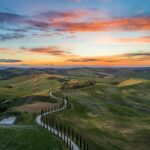
Recognized as a UNESCO World Heritage Site, Val d’Orcia, between Siena and Montalcino, is the postcard Tuscan landscape: rows of cypress trees, rolling hills, isolated stone houses. Best visited in the early morning or at the end of the day, when the horizontal light transforms everything.
◆ Veneto · Northeastern Italy
Venice: Beauty Without Apology
Venice does not appear in Eat, Pray, Love with the same dramatic weight as Rome or Naples. But it is inevitable in the Italian context of the film: no list of places that capture the essence of Italy is complete without it. Venice is proof that Italy has never made concessions to common sense.
The Film’s Locations in Venice
Click a marker for details · Map via CartoDBSt. Mark’s Square and Basilica
What it is
Piazza San Marco is the only space in Venice officially called a piazza (all the others are campi). It is the historical, political, and religious center of the city, with the Basilica di San Marco (11th century), the Doge’s Palace, and the two columns with the city’s symbols: St. Mark and St. Theodore.
Visiting tip
The Basilica has free entry, but the line can be long. The ceiling of gold mosaics (from the 12th century onward) justifies any wait. Go up to the terrace for a view over the square and the lagoon. To enter without queuing, book access online in advance.
Avoid
The historic cafés on the square (Florian, Quadri, Lavena) are beautiful and historic but expensive. An espresso at the counter at Florian is a legitimate cultural experience. A seated meal is a cost that is not worth what it delivers.
The Grand Canal and the Gondolas
What it is
The Grand Canal runs through Venice in an S shape, dividing the city in two. It is the main artery of water traffic, with vaporetti (water buses), taxis, gondolas, and cargo boats. The palace facades that line the canal represent centuries of Venetian architecture, from Gothic to Baroque.
Gondola or vaporetto
A gondola currently costs between 80 and 100 euros for 30 minutes (official fare, for groups of up to 6 people). It is a high price for how long it lasts. Vaporetto no. 1, which travels the entire Grand Canal from Santa Lucia to Piazza San Marco, offers the same perspective for 9.50 euros per ride (or included in a daily pass). For most travelers, the vaporetto is the more sensible choice.
Logistics note: Vaporetto tickets can be bought from the machines at the stops or through the Actv app. A 24-hour pass (25 euros) is the most economical option for anyone staying for a full day.
Rialto Market
What it is
Located beside the Rialto Bridge, the Rialto market has existed since 1097. It is divided into two parts: the Pescheria (fish market, open Tuesday to Saturday mornings) and the Erbaria (fruit and vegetables, open every day). It is one of the most photogenic urban markets in the world and one of the most functional, frequented by professional cooks and local residents.
What to try
Cicchetti, the typical Venetian small bites, served in the bars (bacari) around the market. Baccalà mantecato (creamed cod on bread), sarde in saor (sardines marinated with onion and raisins), puff pastries with veal liver. A round through the bacari with a bicchiere of local white wine costs less than 15 euros and is one of the best meals Venice offers.
Right time
The market is at its best between 7 a.m. and 11 a.m. After 12 p.m., the best fish is already gone and the crowd increases.
Art: Gallerie dell’Accademia and Palazzo Grassi
Gallerie dell’Accademia
The main art gallery in Venice, with the largest collection of Venetian painting from the 14th to the 18th centuries. It includes works by Tintoretto, Veronese, Titian, Giorgione, and Bellini. Essential for anyone who wants to understand the Venetian school, radically different from the Florentine or Roman schools.
Palazzo Grassi and Punta della Dogana
Two institutions controlled by the Pinault Foundation, with world-class contemporary art programming. They are proof that Venice does not live only from its past. The buildings (an 18th-century palace and a former customs house) are as impressive as the works they house.
◆ Tuscany · Regional Capital
Florence: Art, History, and the Bistecca That Needs No Apology
In the book, Florence does not play as central a role as Rome. But the spirit of the Renaissance, the idea that human beings are capable of creating extraordinary beauty, runs through Gilbert’s entire narrative. And no city embodies that spirit with more conviction.
The Film’s Locations in Florence
Click a marker for details · Map via CartoDBThe Duomo and Brunelleschi’s Dome
What it is
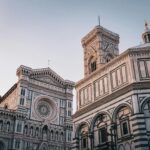
The Cattedrale di Santa Maria del Fiore, with its dome designed by Filippo Brunelleschi and completed in 1436, is the symbol of Florence and one of the greatest engineering achievements in history. The dome is 45 meters in diameter and was built without scaffolding, using a technique invented by Brunelleschi himself.
How to visit
Access to the cathedral interior is free, but requires online booking. The climb to the dome (463 steps, no elevator) offers a panoramic view over Florence that justifies the effort. Book your entry slot in advance, especially in high season.
The baptistery
The Baptistery of St. John, in front of the Duomo, has the bronze doors by Lorenzo Ghiberti, known as the “Gates of Paradise” (1452). Michelangelo is said to have called them worthy of being the entrance to paradise. They are among the most detailed and expressive works of art of the 15th century.
Uffizi Gallery
What it is
One of the largest and most important collections of Renaissance art in the world, housed in the Palazzo degli Uffizi, commissioned by the Medici in the 16th century. The collection includes Botticelli’s Primavera and The Birth of Venus, Michelangelo’s Holy Family, Leonardo da Vinci’s Annunciation, and dozens of other works that defined Western art.
How to visit well
The gallery has more than 50 rooms. A visit without a guide or context can be disorienting. Online booking is mandatory in high season. For a first visit, focus on rooms 10-14 (Botticelli), room 15 (Leonardo), and the Titian rooms. Two to three hours are enough for a focused visit.
Tip: The ticket costs from €25. The entrance line, even with a timed reservation, can take 30 to 45 minutes in July and August. Arrive 15 minutes before your reserved time.
Ponte Vecchio
What it is
The oldest medieval bridge in Florence, built in 1345, which crosses the Arno River. It is the only bridge in Florence that survived destruction during the Second World War. The goldsmith shops along the bridge have existed since the 16th century, when the Medici expelled the butchers who had occupied it before.
Best time to visit
At dawn, when the bridge is almost deserted and the light over the Arno is soft. At sunset, when tourists concentrate in the center and the bridge becomes relatively quiet. Avoid midday from June to September.
Bistecca alla Fiorentina
What it is
A cut of veal from the Chianina breed, from the Val di Chiana area of Tuscany, grilled at high temperature over charcoal or wood. The cut includes the striploin and the fillet separated by the T-bone. It is always served medium-rare or rare: asking for it well done is, for any Florentine, an insult to the meat.
Where to eat
Trattoria Mario (Piazza del Mercato Centrale) and Buca Mario (via del Trebbio) are historic references. For a more contemporary version, Buca dell’Orafo near Ponte Vecchio is consistent. The bistecca is sold by weight (usually 700g to 1 kg for two people) and the price is calculated per 100g or per kg.
Note: A quality bistecca alla fiorentina in an honest trattoria costs between 50 and 80 euros for two people. Be wary of prices far below that.
A final note from ITALIA et al
Eat, Pray, Love worked as an invitation for millions of people to discover Italy. But the best of Italy is not in a film script. It is in the places the film did not show, in the conversations no camera captures, and in the flavors no scene can replicate.
The Italy Gilbert described exists. It is real. And it is available to anyone willing to show up with curiosity and without hurry. Plan your trip to Italy with us.
You may also like
-

The Best Apps for Saving Money in Italy
- Tuscany
- ▪ Abruzzo
- ▪ Aosta Valley
- ▪ Apulia
- ▪ Basilicata
- ▪ Calabria
- ▪ Campania
- ▪ Emilia-Romagna
- ▪ Friuli Venezia Giulia
- ▪ Lazio
- ▪ Liguria
- ▪ Lombardy
- ▪ Marche
- ▪ Molise
- ▪ Piedmont
- ▪ Sardinia
- ▪ Sicily
- ▪ Trentino South Tyrol
- ▪ Umbria
- ▪ Veneto
-

-
-


You need to be part of our community to leave a comment or reply members.
Log in or purchase one of our incredible itineraries!